Gruta da Lapa Doce lies in the municipality of Iraquara, around 70 km from Lençóis, in a region known as the town of caves — and the nickname is no exaggeration: the ground there is among the richest in limestone caves in the country. Lapa Doce is the most impressive on the tourist circuit, and the only one that many people later describe as "bigger than I imagined".
How it formed
The region's limestone is the result of a sea that covered this part of Bahia hundreds of millions of years ago. As the water retreated, a thick layer of soluble rock was left behind. Rainwater, slightly acidic, seeped in through fractures and dissolved the rock over millions of years until it opened up the halls you walk through today.
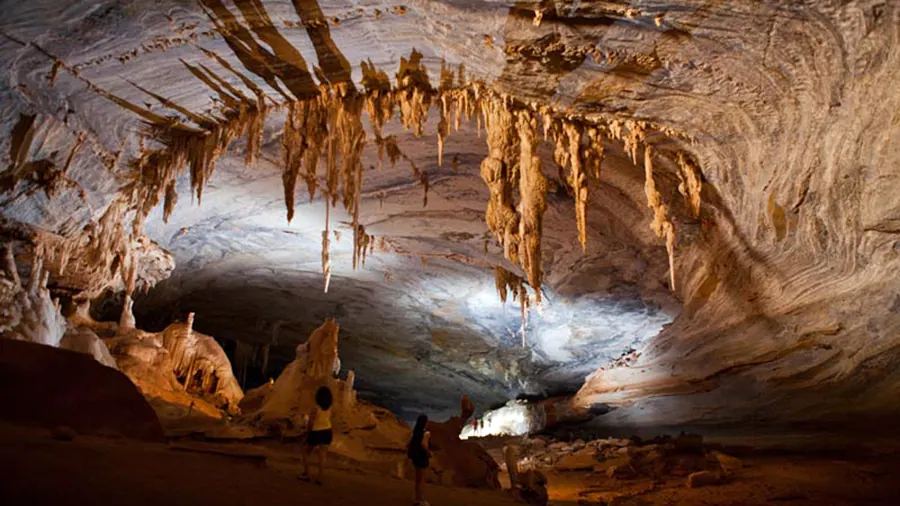
The formations — stalactites descending from the ceiling, stalagmites rising from the floor, columns where the two have met — grow at a rate of millimetres per century. Every large piece you see there took tens of thousands of years.
What the visit is like
Entry is through a doline, a natural opening in the ground formed by the collapse of the ceiling. You go down a staircase and, suddenly, you are in a broad corridor tens of metres wide.
The route runs for hundreds of metres. It is not a cramped cave and does not require crawling: the walk is comfortable, the floor largely flat and the ceiling, in several stretches, as high as a building.
The lighting comes from torches handed out at the entrance — there is no electric light installed, which preserves the environment and, honestly, makes the experience much better. The guide points out the formations and explains what you are looking at.
Difficulty level
Easy. The visit is always guided and requires no technical equipment, prior cave experience or special fitness. It is suitable for families with children and for older travellers.
The real restrictions are others: anyone with severe claustrophobia may be uncomfortable, despite the spacious interior, and the route is not wheelchair accessible.
What to bring
Closed footwear with good grip. The floor has damp, clayey stretches that become slippery.
Clothes that can get dirty. Cave mud stains, and it is common to brush against the walls.
Water. The air is more humid than outside, but the walk makes you thirsty.
The internal temperature is stable and pleasant all year — no jacket needed.
Photography inside the cave
This is what most frustrates an unprepared visitor. The light is extremely low and comes only from the torches, so the phone has a real limitation: the photos come out blurred or very noisy.
If the record matters to you, bring a camera that performs well in low light. And avoid direct flash: it completely flattens the depth of the formations, turning a three-dimensional hall into a white wall. Lighting from the side, with the torch, yields far better results.
It is also worth putting the phone away in some stretches and simply looking — it is the kind of place where the memory beats the photo.
Preservation: why you do not touch
The formations keep growing because water runs over them depositing minerals. The oil from a human hand interrupts that process at the point touched — permanently. A touch today is a scar that will remain there for millennia.
That is why guides insist on the subject, and it is a rule worth respecting without complaint.
How to fit it into your itinerary
Lapa Doce almost always opens the caves itinerary: a morning visit, lunch at a local restaurant, and in the afternoon Pratinha and Gruta Azul — which need the sun high to show the blue water. The day usually closes with the sunset at Morro do Pai Inácio, on the way back.
It is a full day, at around 140 km there and back from Lençóis, but the whole route follows the same road axis, with no zigzagging.
Is it worth it for people who do not like caves?
It usually is. Lapa Doce lacks the elements that normally bother people — it is not cramped, it is not so dark as to be disorienting, it requires no effort. The scale is what impresses, and scale is something that pleases almost everyone.
How long the visit lasts
The guided walk takes around an hour and a half, including the stops for explanation. Add the travel time to Iraquara and lunch, and Lapa Doce comfortably fills the whole morning of your day.
There is no way to speed it up: the visit happens as a group, following the guide's pace, and it is precisely that pace that lets you understand what you are looking at.
Other caves in the region
Iraquara is home to dozens of caves, and some appear on alternative itineraries: Gruta da Torrinha, known for its aragonite formations, and Gruta Azul and Pratinha, which round off the classic circuit.
If you have a specific interest in speleology, it is worth talking to the agency beforehand: you can put together a day focused solely on caves, including less-visited options.
Accessibility and restrictions
The visit is not suitable for wheelchair users or for anyone with very reduced mobility, because of the access staircase and the uneven floor in some stretches.
Children usually enjoy it a great deal, especially for the sense of adventure the torches bring. There is no age restriction, but it is wise to gauge the little ones' stamina for the full route.
Chapada Mar arranges all of this for you: transport on every tour, an accredited local guide, park tickets and fees. Tell us how many days you have and how many people are travelling, and we will build the itinerary and send you a fixed quote — with 10% off for upfront payment by PIX, cash or single-instalment card.