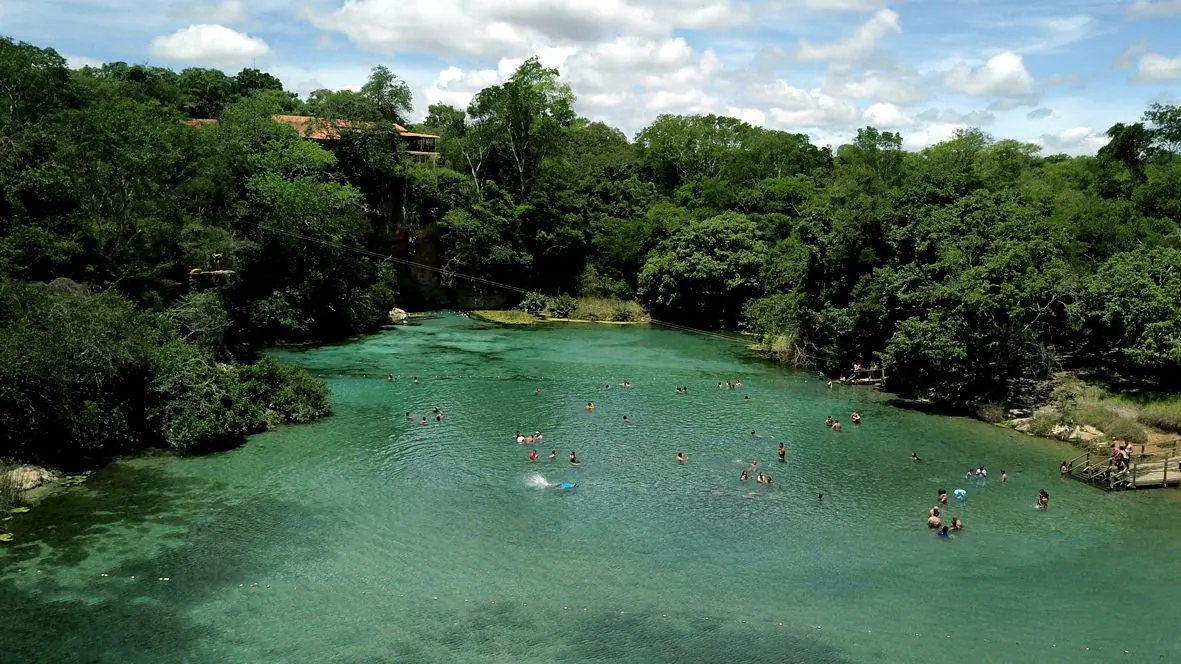
Few images of the Chapada Diamantina impress as much as the turquoise-blue water of Pratinha and Gruta Azul. People often think the photo has been edited. It has not — but there is one detail that decides whether you will see that colour or ordinary water, and almost nobody finds out before arriving.
Why the water is blue
The phenomenon depends on three factors that all have to come together.
Extreme purity. The water is filtered by the limestone and arrives with practically no suspended particles. Clean water absorbs the red wavelengths and reflects the blue ones — the same principle as the open sea, concentrated in a small space.
A pale bottom. The limestone of the bottom returns the light rather than absorbing it, intensifying the colour.
The angle of the sun. This is the decisive factor. The light has to enter through the cave opening at an angle that carries it to the bottom. When that happens, the blue explodes.
The best time — the detail that changes everything
The effect peaks with the sun high, roughly between mid-morning and early afternoon. Outside that window, the same cave shows greenish, dark water.
The intensity also varies over the year: the period between April and September usually yields the strongest blue, because the sun reaches a more favourable angle.
That is exactly why these two attractions rarely appear on their own in an itinerary. They are slotted into a day planned to reach them at the right time — and an itinerary that ignores that detail delivers a much inferior version of the tour.
Pratinha
Pratinha is a private property with facilities set up: a restaurant, a rest area and equipment hire. The river rises inside a cave and flows out into an open lake.
The main activity is floating: with a mask and snorkel, you enter the water and let the gentle current carry you, passing through the mouth of the cave. The visibility is excellent and the fish are clearly visible, many of them a few centimetres away.
There are also activities paid separately — a zip line, kayaking, a treetop course. Not all of them are included in the packages, so it is worth asking beforehand what is included.
Gruta Azul
Gruta Azul works differently: swimming is not permitted. The visit is contemplative, made from a platform on the edge of the pool.
The restriction exists precisely to preserve the phenomenon: any movement stirs sediment from the bottom and clouds the water, and the sunscreen of anyone entering quickly contaminates a small, enclosed volume of water.
It may seem frustrating at first, but it is the reason the colour still exists. And, in practice, the view from above is the one that produces the photos you have seen.
What to bring
Swimwear under your tour clothes. Changing rooms exist, but changing is more practical this way.
A quick-drying towel. It takes up little space in the backpack and dries on the way.
Biodegradable sunscreen. In settings with crystal-clear water and small volume, ordinary sunscreen contaminates quickly — several sites restrict or prohibit its use.
A waterproof camera or a cover for your phone, if you want to record the float.
About expectations
An honest alignment is worth it: Pratinha is a structured, busy attraction, not a wild retreat. In high season there is a queue for the float and plenty of people in the lake area.
What you buy there is the phenomenon of the blue water, which is genuinely unique — not the feeling of solitary discovery. Anyone who goes knowing that usually comes away enchanted; anyone expecting solitude comes away frustrated.
How to fit it into your itinerary
The classic sequence is: Lapa Doce in the morning, lunch, Pratinha and Gruta Azul in the middle of the day (in the best light), and Morro do Pai Inácio in the late afternoon, on the way back to Lençóis.
It is a long day, but it is the day that packs the most different attractions into a single itinerary — cave, blue water and viewpoint.
How long to stay
Pratinha usually takes two to three hours, counting the float, the swim in the lake and the time to rest. Gruta Azul is quick — around 20 minutes, since the visit is contemplative.
Added to the journey and the morning visit to Lapa Doce, the two round out a full day of touring.
The float step by step
You are given a mask, snorkel and life jacket, enter the lake from the bank and swim to the mouth of the cave. The current carries you slowly inwards, and the route is short — it is not diving, it is floating and looking down.
You do not need to be a strong swimmer: the life jacket keeps you at the surface the whole time, and there is always someone accompanying you. Anyone nervous of water can do just the open-lake part.
About preserving the water
The volume of water in these caves is small and renews slowly. Ordinary sunscreen, insect repellent and residue from hair products form a film that alters the transparency — and transparency is exactly the product there.
That is why the guidance is to enter the water with no product at all, or to use only biodegradable sunscreen applied well in advance. It is a small rule that preserves the attraction for those who come later.
Chapada Mar arranges all of this for you: transport on every tour, an accredited local guide, park tickets and fees. Tell us how many days you have and how many people are travelling, and we will build the itinerary and send you a fixed quote — with 10% off for upfront payment by PIX, cash or single-instalment card.